Sunglasses Styles for Round Faces That Add Definition
Find the sunglasses styles for round faces that add angles, lengthen features, and skip the frames that make cheeks look fuller than they are.
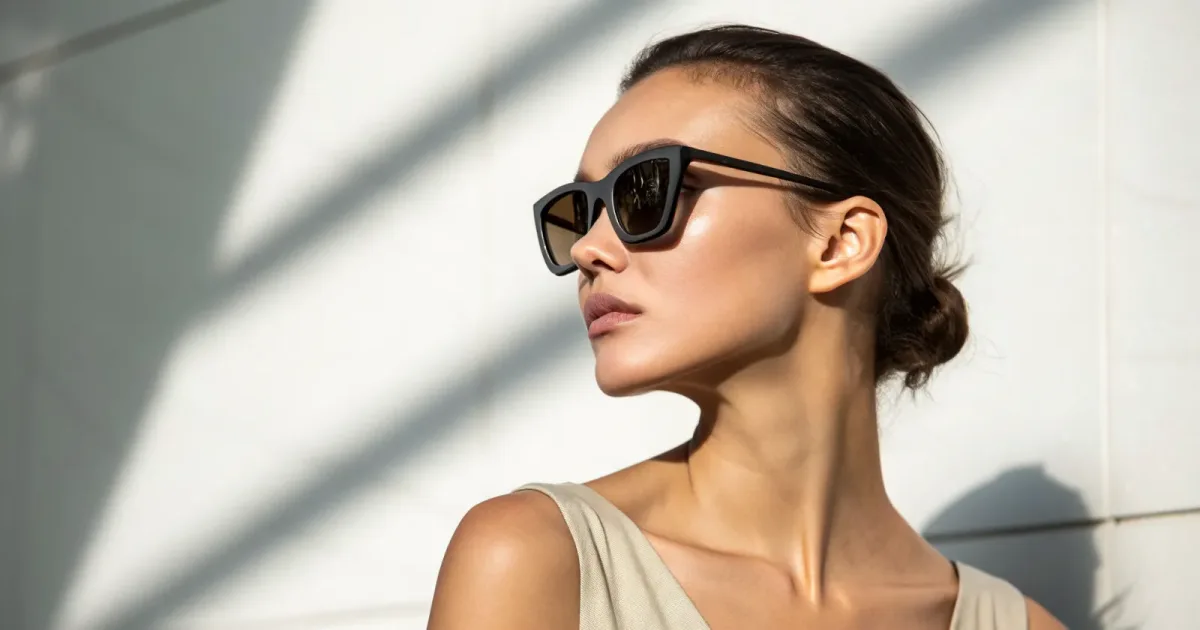
If every pair you try on seems to make your face look rounder, you're not imagining it. A round face has soft, curved lines and roughly equal width and length, with full cheeks and a rounded jaw. Put a round frame on top of that and you've doubled down on the curves. The fix isn't complicated, but it is specific: you want frames that add angles and definition where your face doesn't have them.
This guide leads with the shapes that flatter a round face, then folds in the questions that come attached to it: which aviators to look at, how Oakley's performance line fits in, what the 70s revival actually means when you're shopping now, and how the naming conventions differ when men and women browse the same wall of frames.
Why the wrong frames make a round face rounder
Face-shape advice works on contrast. A round face lacks hard edges, so the frames that suit it best supply the edges instead. Angular, geometric shapes cut straight lines across the softness and create the impression of structure. Frames that sit high on the bridge and stretch a little wider than your cheeks pull the eye outward and upward, which lengthens the face and slims it. That's the whole logic in one sentence.
The common worry in style threads isn't whether this works. It's whether sharp frames will look too severe, or just not feel like you. That's fair. The trick is matching the degree of angularity to your comfort level rather than abandoning angles altogether. A softly squared frame with rounded corners still does the job without looking like it belongs on someone else's face.
The shapes that flatter a round face
Start here. These are the categories worth trying first, in rough order of how reliably they land.
Square and rectangular frames. The straightforward answer. Straight top and bottom edges add horizontal and vertical lines that a round face is missing. Rectangular runs a touch more formal, square a touch more fashion-forward.
Geometric and angular frames. Hexagonal, octagonal, and other cut-corner shapes bring definition without the seriousness of a hard rectangle. Good middle ground if full square feels too much.
Aviators. The teardrop shape has flat top bars and angled lower edges, so it adds structure while its lightness keeps things from looking heavy on the face.
Cat-eye frames. The upswept outer corners lift the cheeks visually and draw the eye up and out, which counters roundness nicely. A favourite for exactly this reason.
Wayfarer-style frames. The trapezoidal front gives you angles at the browline and a wider stance across the face.
What to skip, or at least approach with caution: perfectly round frames, small circular lenses, and anything with heavy curves and no straight edges. They echo your face shape instead of balancing it. That doesn't make them forbidden, but you're working uphill.
Aviators: still the safe bet
If you only try one shape, try this one. Aviators started as equipment, not fashion. Bausch & Lomb developed them for U.S. Army Air Corps pilots in the mid-1930s to cut glare at altitude, and Ray-Ban released the design to the public in 1937. The teardrop lens and thin metal frame have barely changed since, which tells you something about how well the shape works.
For a round face, aviators help because the flat top bar draws a horizontal line across the brow and the lenses taper to a point at the bottom, adding the angle your jaw doesn't have. Look for a version that sits a little wider than your cheekbones and has a defined, squared-off top rather than a soft dome. The metal double or triple bridge also lends structure. Aviators show up constantly on lists of timeless, old-money staples for the same reason they suit round faces: the shape is doing quiet, consistent work.
Wayfarers and squared frames
The Wayfarer is the other pillar. Ray-Ban introduced the trapezoidal plastic frame in 1952), and it was one of the first sunglasses designs sold as a fashion object rather than pure eye protection. That heritage is why it reads as neutral and confident rather than trendy.
On a round face, a Wayfarer or any strong squared acetate frame adds a firm browline and straight edges the face is short on. Go for a medium-to-large size so the frame is at least as wide as the widest part of your face. Too small and it gets swallowed, making the cheeks look fuller by comparison. This is also the frame that anchors most casual outfits, and it sits comfortably inside a good streetwear look without trying too hard.

Try before you buy
Try on outfits, accessories and more on yourself in seconds — and save money and time on returns.
Try it onCat-eye frames for lift
Cat-eye frames are one of the most effective round-face shapes and often the most overlooked by men, who tend to file them as women-only. They aren't. The upswept corners lift the visual weight toward the temples, which lengthens the face and sharpens the cheekbones. A subtle, angular cat-eye works on plenty of faces regardless of who it's marketed to.
If a dramatic sweep feels like too much, look for a squared cat-eye where the outer corners flick up only slightly. You get the lift without the vintage-bombshell signal. Either way, this shape rewards trying it on, because the right amount of flick varies a lot from face to face.
The 70s revival, minus the history lesson
When people search for 70s sunglasses, they usually want to buy something with that flavour now, not read about the decade. So here's the practical version. Two silhouettes define the era: oversized round frames and gradient-tinted aviators, both of which went mainstream in the 1970s thanks to figures like John Lennon in round wire frames and Jacqueline Kennedy Onassis in oversized shapes.
There's a tension for round faces here. Big round 70s frames are exactly the shape that can make a round face rounder. If you love the look, don't force a perfect circle. Reach for an oversized frame with squared or hexagonal edges instead, which keeps the generous 70s scale while adding the angles you need. The oversized aviator with a gradient lens is the safer retro route, giving you era-correct styling and a flattering shape at once.
Oakley and the performance side
Not every pair is about your jawline. If you run, ride, or drive into the sun, the questions change from shape to function. Oakley built its identity here. The company started in 1975 selling motorcycle handgrips before Jim Jannard moved it into eyewear, and its first sunglasses, the Eyeshade, launched in 1984 as a single curved shield lens built for cyclists and runners rather than the usual two-lens format. That shield DNA still runs through the line.
Roughly, the performance styles sort like this:
Shield and wraparound frames for cycling and running, where a single curved lens gives a wide, uninterrupted field of view and stays put during movement.
Wrapped semi-rimless styles for general sport and driving, balancing coverage with a lighter feel.
Lifestyle squared frames for everyday wear, where the performance heritage is styling rather than function.
For a round face, the good news is that shield and wraparound shapes are naturally angular and wide, so they suit you while doing their sport job. The one thing to watch is scale: a huge wrap can overwhelm a shorter face, so size it to your proportions.
A plain-language glossary of frame styles
If you just want the names so you can shop with a vocabulary, here they are. This is the shorthand most brands use, and it applies across men's and women's ranges even where the marketing splits them.
Style | Shape in one line | Best for round faces? |
|---|---|---|
Aviator | Teardrop metal frame, flat top bar | Yes, reliably |
Wayfarer | Trapezoidal acetate front | Yes |
Round | Circular lenses, wire or acetate | Least flattering |
Clubmaster / browline | Heavy top, thin or rimless bottom | Yes, adds a browline |
Cat-eye | Upswept outer corners | Yes |
Square / geometric | Straight edges, cut corners | Yes |
Shield / wraparound | Single curved lens, sporty | Yes, watch the size |
The men's-versus-women's distinction is mostly about sizing and marketing rather than shape rules. Frame width scales with face width, and men's ranges tend to run larger, but a round face is a round face. The same shape logic applies to both, which is the same framework you'd use to match a haircut to a square face: identify what the face lacks, then supply it.
Lenses matter as much as the frame
A frame that suits you is only half the purchase. The lens decides what the sunglasses actually do for your eyes, and this is where a lot of good-looking pairs fall short.
Start with UV. The American Academy of Ophthalmology advises choosing lenses labeled as blocking 99 to 100% of UVA and UVB rays, and makes a point worth remembering: how dark or what colour the lens is tells you nothing about its UV protection. A pale tint can block more than a near-black one. Look for the label, often marked as UV400, not the shade.
Then decide on extras based on how you'll use them:
Polarized lenses carry a chemical film aligned to block horizontally scattered light, which is what cuts glare bouncing off water, snow, and pavement. Worth it for driving, boating, and bright open spaces. Less essential for casual city wear.
Gradient lenses, darker at the top and clearer toward the bottom, are the 70s-associated finish. They're good for driving because you can still see the dashboard, and they read softer than a flat dark tint.
Mirror and contrast tints are mostly a sport and style choice and don't change UV performance on their own.
Sunglasses have been sold as fashion, not just function, for roughly a century. Foster Grant helped mass-market them to American shoppers through Woolworth's in the 1920s and 30s, which is when the accessory-versus-utility split we still navigate today first opened up. You're allowed to want both. Just make sure the utility part is actually there.
Test the shape claim on your own face
Every rule above is a starting point, not a verdict. Face-shape guidance describes tendencies, and your specific features, glasses prescription, and how you actually wear a frame can override the chart. The single most common regret people describe online is buying a pair, wearing it once, and realising it doesn't sit right on their face.
That's the case for checking before you pay. Using virtual try-on for eyewear lets you put an aviator, a squared Wayfarer, and a cat-eye on the same photo of your own face and compare them side by side, which is far more useful than imagining it from a product shot. Try the shape this guide recommends, then try the one you were told to avoid. If the angular frame flatters you the way the logic predicts, you'll see it immediately. If your face is the exception, you'll see that too, and you'll have saved yourself a return.
Buy the pair that looks right on you, not the one that looks right on the model. The shape rules get you to a short list fast. Your own reflection settles the rest.

Tobias Scharl
Further reading
Fringe Texture Explained: In Hair and On Clothes
Fringe texture means different things on hair versus fashion pieces. Here's how to spot good texture in bangs and wear fringe on clothes without looking
What to Wear to a Funeral: A No-Stress Guide
Not sure what to wear to a funeral? Here's how to choose respectful, appropriate clothing fast, from suits and dresses to shoes and tricky edge cases.